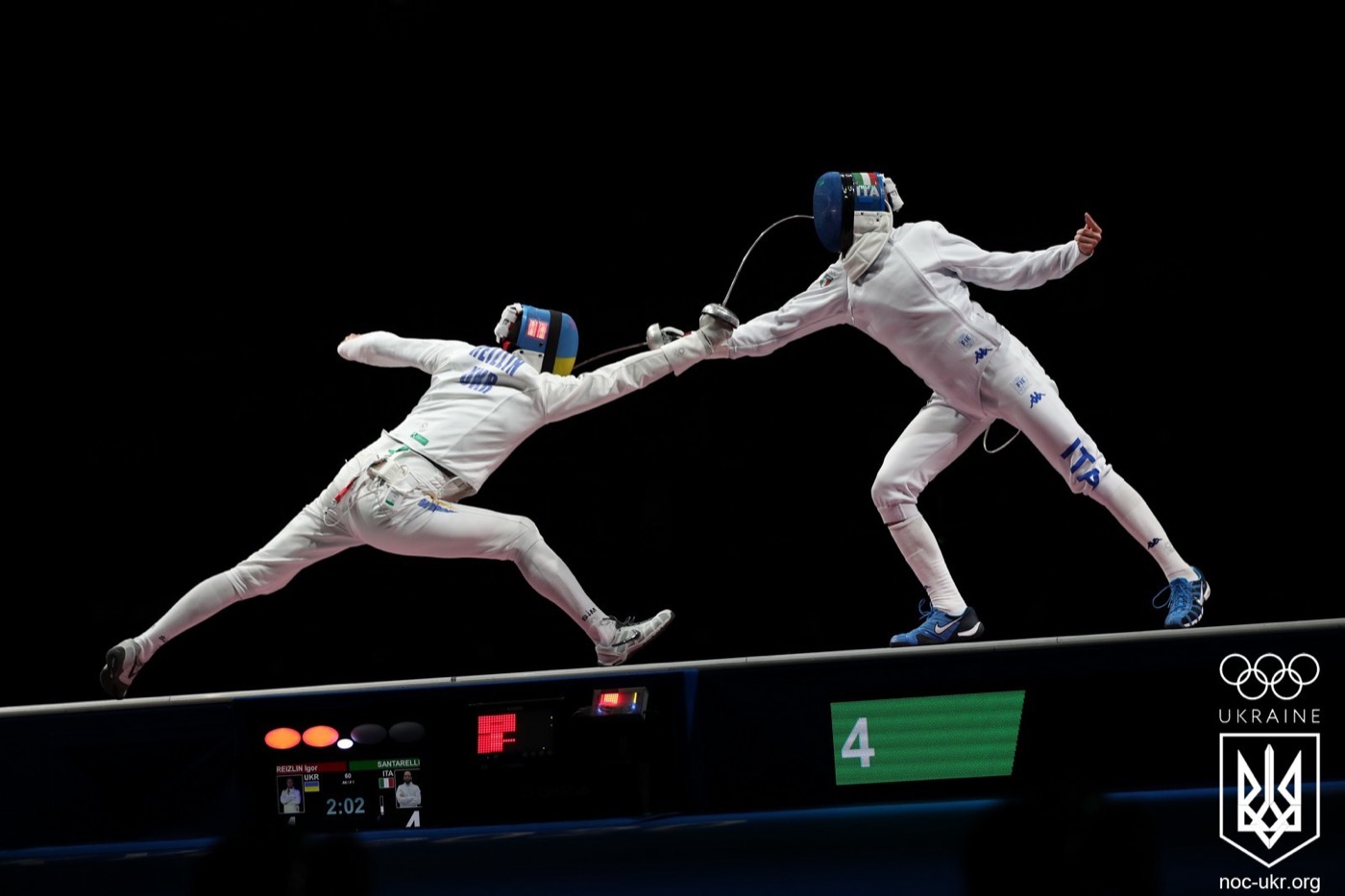
Fencing at the Tokyo 2020 Olympics
Fencing at the Tokyo 2020 Olympics ran from July 24 to August 1, 2021, at Makuhari Messe in Chiba, Japan, with 12 medal events across foil, epee, and saber. The Games were postponed a full year by the COVID-19 pandemic but kept the “Tokyo 2020” name. Athletes competing as the Russian Olympic Committee (ROC) topped the fencing medal table with 8 medals (3 gold, 4 silver, 1 bronze), more than any other nation. This guide is a results-focused retrospective — the Games are long over — but unlike fencing.net’s Paris 2024 guide, this one links fencing.net’s own live event coverage from 2021, published as the results came in.
Quick facts
- Games dates: July 23 – August 8, 2021, in Tokyo, Japan (originally scheduled for July 24 – August 9, 2020, postponed one year by COVID-19).
- Fencing dates: July 24 – August 1, 2021 — 9 consecutive days, starting the day after the Opening Ceremony.
- Venue: Makuhari Messe Hall B, a roughly 855,000-square-foot convention center in Chiba, about 20 miles east of central Tokyo. Wrestling and taekwondo shared the complex in Hall A; karate, originally also planned for Makuhari Messe, was ultimately held at the Nippon Budokan instead.
- Events: 12 medal events — individual and team, men’s and women’s, in each of foil, epee, and saber.
- Participation: 261 fencers from 42 nations, per Wikipedia and Olympedia’s independently matching totals.
- Top medal-winning “nation”: athletes competing as the ROC (Russian Olympic Committee) won 8 medals (3 gold, 4 silver, 1 bronze) — more golds and more total medals than any other team.
- Format: individual events ran first (July 24–26, two per day), followed by team events (July 27 – August 1, one per day).
Where did fencing take place at Tokyo 2020?
Fencing was held at Makuhari Messe, one of Japan’s largest convention centers, in Chiba — about 20 miles (32 km) east of central Tokyo. Fencing used Hall B of the complex, while Hall A hosted wrestling and taekwondo; karate was moved to the Nippon Budokan rather than sharing the venue as originally planned. The fencing hall held a spectator capacity of 8,000, though Tokyo 2020 was contested without spectators under Japan’s COVID-19 state of emergency. (EssentiallySports venue overview)
When did Olympic fencing happen at Tokyo 2020?
Fencing ran for 9 consecutive days, from Saturday, July 24 through Sunday, August 1, 2021 — the day after the Opening Ceremony. As at later Games, the first three days carried the six individual events, two per day, followed by six days of team events, one per day:
| Date | Event(s) |
|---|---|
| July 24 | Men’s saber individual, Women’s epee individual |
| July 25 | Men’s epee individual, Women’s foil individual |
| July 26 | Men’s foil individual, Women’s saber individual |
| July 27 | Women’s team epee |
| July 28 | Men’s team saber |
| July 29 | Women’s team foil |
| July 30 | Men’s team epee |
| July 31 | Women’s team saber |
| August 1 | Men’s team foil |
This is the same nine-day, individual-then-team structure fencing.net’s Paris 2024 and Los Angeles 2028 guides describe for those Games.
What events were contested in fencing at Tokyo 2020?
Twelve medal events, split evenly between individual and team competition, for both men and women, in each of the three weapons — the same 12-event program used at Paris 2024 and planned for Los Angeles 2028:
| Weapon | Individual | Team |
|---|---|---|
| Foil | Men’s, Women’s | Men’s, Women’s |
| Epee | Men’s, Women’s | Men’s, Women’s |
| Saber | Men’s, Women’s | Men’s, Women’s |
Tokyo 2020 was the first Olympics to hold all six team events (men’s and women’s, in all three weapons) on the same program.
Who won each fencing event at Tokyo 2020? (Full medal results)
The table below lists every medalist, cross-checked against Wikipedia’s Fencing at the 2020 Summer Olympics and Olympedia’s official results database — the two independently sourced and they agree on every result below. Where fencing.net covered an event’s result live in 2021, the event name links to fencing.net’s own article; the men’s team epee final has no fencing.net article, so it links to Wikipedia’s results page instead.
| Event | Gold | Silver | Bronze |
|---|---|---|---|
| Men’s foil individual | Cheung Ka-long (Hong Kong) | Daniele Garozzo (Italy) | Alexander Choupenitch (Czech Republic) |
| Men’s epee individual | Romain Cannone (France) | Gergely Siklosi (Hungary) | Ihor Reizlin (Ukraine) |
| Men’s saber individual | Aron Szilagyi (Hungary) | Luigi Samele (Italy) | Kim Jung-hwan (South Korea) |
| Women’s foil individual | Lee Kiefer (United States) | Inna Deriglazova (ROC) | Larisa Korobeynikova (ROC) |
| Women’s epee individual | Sun Yiwen (China) | Ana Maria Popescu (Romania) | Katrina Lehis (Estonia) |
| Women’s saber individual | Sofia Pozdniakova (ROC) | Sofya Velikaya (ROC) | Manon Brunet (France) |
| Men’s team foil | France | ROC | United States |
| Men’s team epee | Japan | ROC | South Korea |
| Men’s team saber | South Korea | Italy | Hungary |
| Women’s team foil | ROC | France | Italy |
| Women’s team epee | Estonia | South Korea | Italy |
| Women’s team saber | ROC | France | South Korea |
A note on “ROC”: following a state-sponsored doping scandal, the Court of Arbitration for Sport ruled in December 2020 that Russian athletes could compete at Tokyo 2020, but not under Russia’s name, flag, or anthem for a two-year period. The IOC designated the team “ROC,” after the Russian Olympic Committee, so results above credit “ROC,” not “Russia,” per the official record. (NBC Olympics explainer)
Which country won the most fencing medals at Tokyo 2020?
Athletes competing as the ROC won the most fencing medals overall — 8 total (3 gold, 4 silver, 1 bronze) — more golds and more total medals than any other team, built on strength in saber and foil rather than a single dominant fencer. France was next with 5 medals (2 gold, 2 silver, 1 bronze), followed by Italy and South Korea with 5 medals each (0 gold for Italy, 1 gold for South Korea). Thirteen NOCs/teams won at least one fencing medal, and nine of them won at least one gold: ROC (3), France (2), and Hong Kong, Hungary, the United States, China, Estonia, Japan, and South Korea (1 each). (Tallied from the medal table above, cross-checked against Wikipedia and Olympedia.)
What were the standout storylines from Tokyo 2020 fencing?
- Cheung Ka-long won Hong Kong’s second Olympic gold medal ever, beating defending champion Daniele Garozzo of Italy 15–11 in the men’s foil individual final — ending a 25-year wait since Lee Lai-shan’s 1996 windsurfing gold, Hong Kong’s first. (South China Morning Post; fencing.net’s live report)
- Lee Kiefer became the first American to win Olympic gold in women’s foil individual, a result fencing.net covered live as it happened. She went on to repeat as champion at Paris 2024.
- Romain Cannone won men’s epee individual as a major underdog — fencing.net’s live coverage noted he entered the tournament ranked outside the world’s top 40. (fencing.net’s report)
- Aron Szilagyi won his third consecutive individual Olympic saber title, defeating Luigi Samele of Italy in the final — a run that made him the first fencer in Olympic history to win the same individual weapon three times. (fencing.net’s report)
- Estonia won its first-ever Olympic medal in women’s team epee, and it was gold — Estonia beat South Korea 36–32 in the final. (fencing.net’s report)
- ROC’s strength was concentrated in the women’s events: gold in both women’s team saber and women’s team foil, plus both silver and bronze in women’s foil individual (behind Kiefer) and both gold and silver in women’s saber individual — four of ROC’s eight medals came from the women’s saber and foil individual events alone.
How does Olympic fencing scoring work?
Each of the three weapons — foil, epee, and saber — has its own target area and rules:
- Epee is a point weapon, which means touches are scored only with the tip of the blade. The valid target is a fencer’s entire body, and there’s no right-of-way rule — if both fencers land a touch within about 1/25 of a second of each other, both score.
- Foil is also a point weapon, but the valid target is limited to the torso. Foil is a conventional weapon, which means that when both fencers land a hit, a referee applies a set of priority rules — “right of way” — to decide who scores.
- Saber is an edge weapon, which means a fencer can score by hitting with any part of the blade, not just the tip. The valid target is everything above the waist (excluding the hands), and like foil, saber uses right-of-way rules.
For a full beginner-friendly walkthrough, see fencing.net’s Welcome to the Olympic Sport of Fencing guide.
fencing.net’s original event-by-event coverage
fencing.net covered Tokyo 2020 live in 2021. Each link below is the original event coverage hub, with schedules, draws, and results as they were reported at the time:
- Men’s foil individual
- Men’s epee individual
- Men’s saber individual
- Women’s foil individual
- Women’s epee individual
- Women’s saber individual
- Men’s team foil
- Men’s team epee
- Men’s team saber
- Women’s team foil
- Women’s team epee
- Women’s team saber
Frequently asked questions
Did fencing.net cover the Tokyo 2020 Games live? Yes. Unlike Paris 2024 — which fencing.net’s news archive predates — fencing.net reported on Tokyo 2020 fencing as it happened in 2021, with a dedicated coverage page for each of the 12 events (linked above) and result articles for 11 of the 12 finals.
Why is it called “Tokyo 2020” if it happened in 2021? The Games were postponed a full year by the COVID-19 pandemic, from their original July–August 2020 dates to July 23 – August 8, 2021. The IOC and Tokyo organizers kept the “Tokyo 2020” name rather than renaming the Games “Tokyo 2021.”
Why does the medal table say “ROC” instead of “Russia”? Following a state-sponsored doping scandal, the Court of Arbitration for Sport ruled that Russian athletes could compete at the 2020 and 2022 Games only under a neutral designation, without Russia’s name, flag, or anthem. The IOC assigned the acronym “ROC,” for the Russian Olympic Committee.
Was wheelchair fencing part of Tokyo 2020? Wheelchair fencing is a Paralympic sport, not an Olympic one. It was contested at the Tokyo 2020 Paralympic Games (August 24 – September 5, 2021), separately from the Olympic program described here.
How many fencers competed at Tokyo 2020? 261 fencers from 42 nations, per Wikipedia’s infobox and Olympedia’s event totals, which independently match.
What’s next for Olympic fencing? Fencing returned for Paris 2024, where France topped the medal table; see fencing.net’s Fencing at the Paris 2024 Olympics guide. The next Games are Los Angeles 2028 — see Fencing at the Los Angeles 2028 Olympics for what’s confirmed so far.
Related fencing.net guides
- Welcome to the Olympic Sport of Fencing — a full beginner’s explainer of the three weapons, right of way, and how to get started fencing yourself.
- Fencing at the Paris 2024 Olympics — the following Games, with a full medal-results retrospective in the same format as this page.
- Fencing at the Los Angeles 2028 Olympics — what’s known so far about the next Games.
- How do you qualify for the Olympics in fencing? — fencing.net’s explainer, published ahead of Tokyo 2020.
- How do Olympic host country slots work in fencing? — background on host-nation quota places.
- Find a Fencing Club — how to find a local club if reading about Tokyo 2020 makes you want to pick up a blade.
Sources
- Wikipedia — Fencing at the 2020 Summer Olympics (venue, dates, full medal table, participation figures)
- Olympedia — Fencing at the 2020 Summer Olympics (independent cross-check of the full medal table, per-event dates, venue)
- Wikipedia — Men’s team epee (used in the medal table since fencing.net did not publish a result article for this event)
- EssentiallySports — Makuhari Messe venue overview (venue, hall assignments, capacity)
- NBC Olympics — What does ROC stand for, and why did Russia get banned from the Olympics? (ROC designation background)
- South China Morning Post — Cheung Ka-long makes history for Hong Kong with fencing gold (Cheung Ka-long storyline)
- fencing.net’s own 2021 live event coverage, linked throughout this page